
Get bulk orders for 30% less than local suppliers, plus free samples.
Get bulk orders for 30% less than local suppliers, plus free samples.
You engineer a piece of heavy machinery built to last 20 years. Yet, the first thing to fail is often a $0.50 warning sticker.
After 15 years in the custom label printing industry, the most expensive mistake I see procurement teams make is treating industrial stickers like promotional handouts. An industrial label is not a decoration. It is a functional, compliance-critical component of your equipment. If you are sourcing labels for harsh environments, you cannot buy based on aesthetics alone; you must engineer the label for survival.
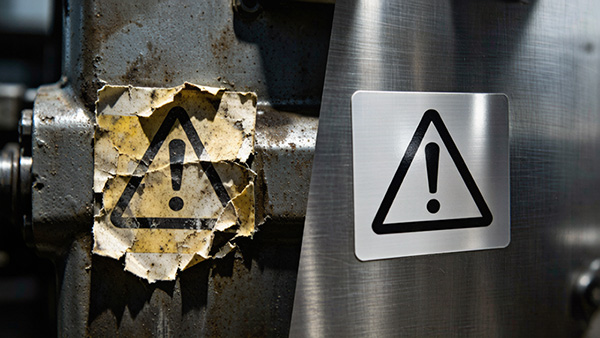
Standard vinyl or paper stickers are designed for laptops, indoor packaging, and dry environments. When you apply them to a CNC machine, a solar inverter, or a chemical drum, physics immediately takes over. Here is exactly why standard labels fail:
Thermal Shock: Standard adhesives melt and ooze at around 150°F (65°C), causing the label to slide down the equipment housing. Conversely, in freezing outdoor conditions, cheap adhesives crystallize, lose their tack, and simply fall off.
UV Degradation: Without an industrial-grade laminate, UV rays will bleach critical warning symbols (like red fire hazard icons) into a blank white square within six months.
Chemical and Solvent Attack: Hydraulic fluid, motor oil, and aggressive cleaning solvents will dissolve standard printing inks almost instantly, rendering barcodes and serial numbers unreadable.
The True Cost: The real price of a failed sticker isn't the cost to reprint it. It is the failed safety inspection (OSHA/UL), the liability of a missing hazard warning, and the severe damage to your brand's perceived quality. A premium machine shouldn't have a peeling, curling sticker.
Stop thinking about "buying stickers" and start thinking about "specifying a material stack." An industrial label is constructed in three layers. Get one of these wrong, and the label fails.
The Rookie Mistake: Specifying standard PVC (Vinyl) for everything. While vinyl is great for curving around pipes, it has poor dimensional stability under high heat—meaning it shrinks, exposing a sticky ring of adhesive that collects dirt.
The Engineer's Choice: PET (Polyester). PET is the gold standard for nameplates and rating plates. It does not stretch, it does not shrink, and it maintains its structural integrity well above 250°F (120°C).
Powder-coated metals, textured cast iron, and plastics like HDPE are what we call Low Surface Energy (LSE) materials. They are "slippery" at a microscopic level. A standard acrylic adhesive will literally fall off an LSE surface within days. You must specify a high-coat-weight, aggressive rubber-based or modified acrylic adhesive designed specifically to bite into textured or LSE surfaces.
Never leave your ink exposed. Industrial environments involve physical abrasion (workers scraping against machines) and chemical spills. We apply a heavy-duty clear overlaminate. If your equipment encounters harsh solvents like MEK (Methyl Ethyl Ketone), brake fluid, or continuous direct sunlight, the laminate acts as a sacrificial shield.
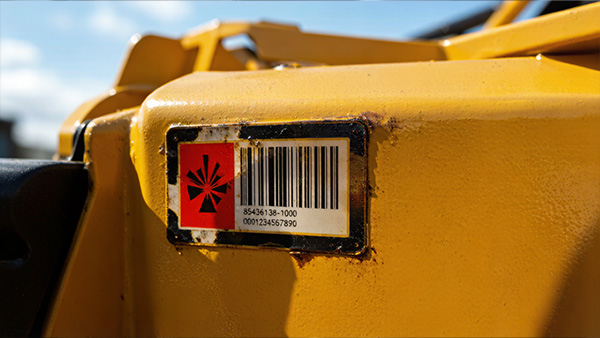
Different operating environments demand completely different material stacks. Here is how we engineer solutions for specific sectors:
Excavators and cranes face constant dirt, high-pressure washing, and flying debris. We specify an ultra-thick polycarbonate laminate (Lexan) that acts as a bulletproof vest against physical abrasion, combined with an adhesive that bonds securely to heavy cast iron.
Solar inverters and AC units live outdoors 365 days a year. The enemy here is UV radiation and thermal expansion. Our outdoor equipment labels utilize specialized UV-blocking laminates to ensure safety warnings remain legible for 5+ years without fading.
Control cabinets require precise die-cuts for buttons and switches, and they must be non-conductive to prevent short circuits. We use precision digital die-cutting on dielectric (insulating) PET films to ensure perfect fit and electrical safety.
If your company exports equipment to North America or Europe, your labels face a strict legal hurdle. Regulatory bodies like UL (Underwriters Laboratories) and CSA require that safety warnings and rating plates remain securely attached and legible after rigorous testing (including oven aging, humidity, and even flammability tests).
If your label burns or peels off during inspection, your entire piece of equipment fails compliance.
Do not risk a six-figure export order over a cheap sticker. By utilizing tested substrates and flame-retardant materials, we ensure your equipment clears customs and site inspections without a hitch.
Engineering the right label is only half the battle; managing the supply chain is the other. You might need 50 labels for a beta-test prototype this month, and 5,000 for mass production next quarter.
Traditional printing requires expensive setup plates for every design change. At StickerForge, we leverage high-resolution digital presses. This means zero plate fees. We can print Variable Data (VDP)—such as unique serial numbers or sequential barcodes—on every single label without slowing down production.
Explore our full range of
custom industrial labels
to see how we adapt our production to your specific manufacturing line.
A true industrial-grade sticker is defined by its material stack: a dimensionally stable substrate (like PET), an aggressive adhesive formulated for the specific surface energy of the equipment, and a heavy-duty laminate that resists UV rays, abrasion, and chemicals.
Yes. We understand that R&D teams need small runs before committing to mass production. Because we use digital printing technology, we do not charge expensive plate fees. We can supply you with 50 perfectly engineered labels for your prototypes, and effortlessly scale to 50,000 when you go to market.
Stop risking your equipment's compliance on cheap, standard stickers. Let our engineers review your specs and recommend the exact material and adhesive your operating environment demands.
Get a Technical Quote & Material Consultation





 +8618128095554
 sales@stickerforgeco.com
 +8618128095554