Get bulk orders for 30% less than local suppliers, plus free samples.
Get bulk orders for 30% less than local suppliers, plus free samples.
📖 5 min read
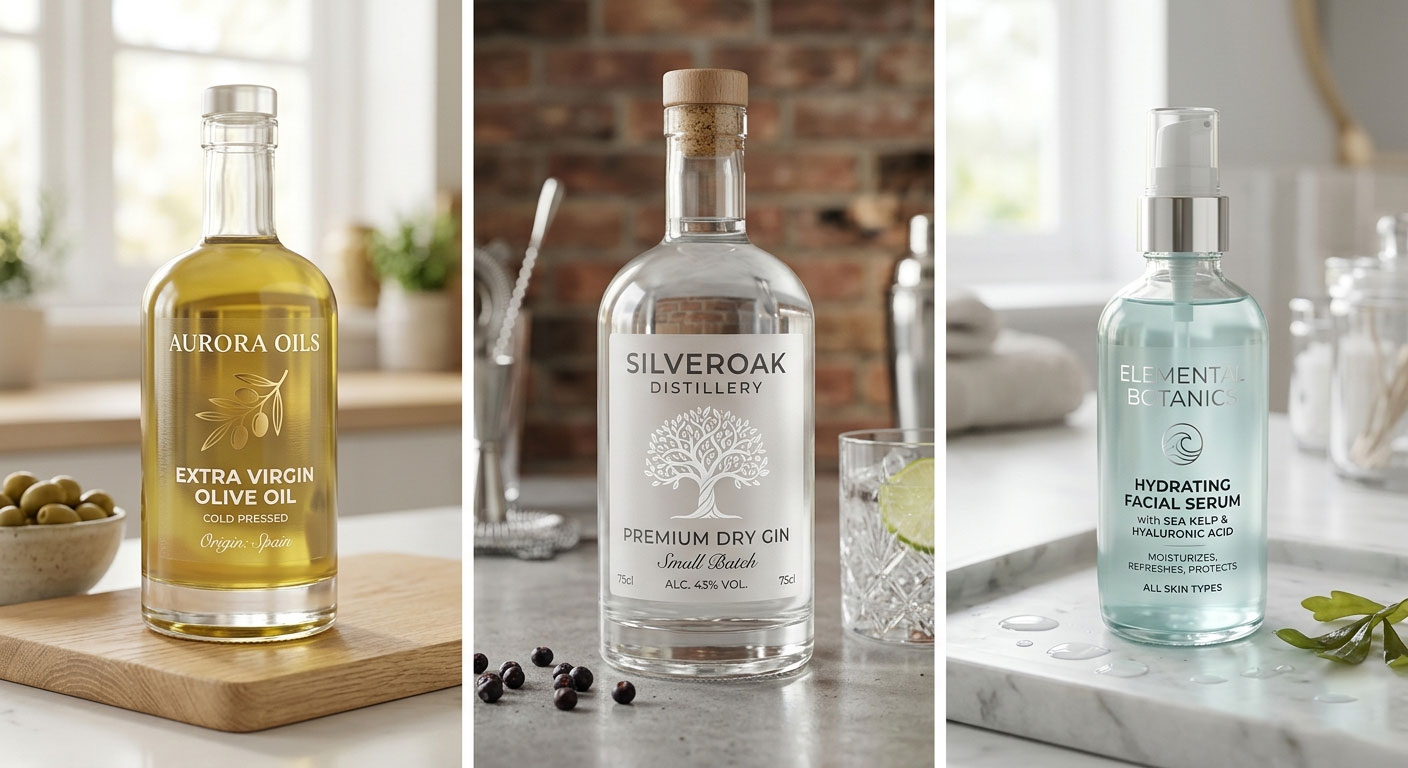
Walk down any beverage or premium skincare aisle, and you'll see it: the "no-label look"—a product that appears to have no label at all, with graphics floating directly on the glass.
So, can clear labels be used on glass bottles?
Yes, absolutely. When engineered correctly, clear labels turn into an invisible canvas that elevates your product's perceived value. But without the right materials, adhesive, or design approach, they can bubble, peel, or—worst of all—make your brand unreadable.
Here at StickerForgeco, we manufacture pressure-sensitive labels and stickers for hundreds of brands. In this guide, we'll share exactly what makes clear labels succeed on glass, from adhesive chemistry to artwork traps you must avoid.
Glass is non-porous, smooth, and often exposed to moisture (condensation) or temperature changes (refrigeration). This demands specific materials.
| Feature | Recommended Option | Why It Works on Glass |
|---|---|---|
| Film | Clear BOPP (polypropylene) or clear PET (polyester) | Rigid yet conformable; resists scuffs, oils, and moisture. |
| Adhesive | Clear permanent acrylic | High tack, bonds to low-surface-energy glass, resists fogging. |
| Laminate (optional) | Gloss or matte UV lam | Protects ink; matte hides minor bubbles, gloss enhances vibrancy. |
A flat, smooth glass bottle is the easiest surface. But your customers often have curves, embossing, or colored glass.
Curved or tapered bottles → Use conformable films like MDO (mono-oriented) or thin-gauge PET. They flex around radiuses without lifting at the edges.
Textured or embossed glass → Expect air pockets around recesses. Solution: use a thicker adhesive coat weight (available from StickerForgeco on request) or switch to a small opaque background.
Frosted vs. high-gloss glass → High-gloss reflects light and will spotlight every tiny wrinkle or dust speck. Frosted glass is more forgiving. Always test your clear label on an actual bottle—not a flat proof.
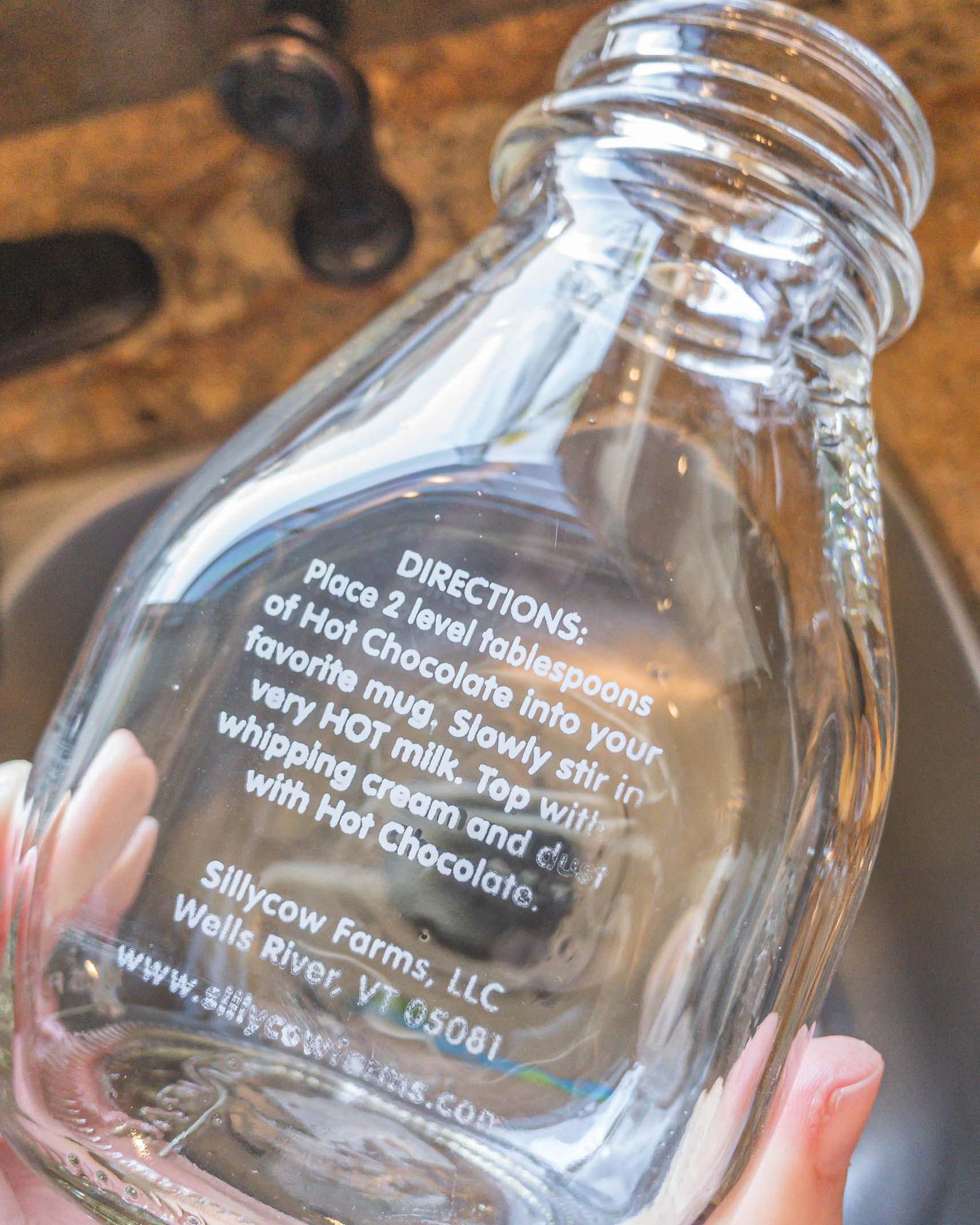
This is the #1 mistake brands make: they assume "clear label" means no background ink. Then they wonder why their logo disappears against dark soda or amber oil.
You must use a white ink underprint strategically.
What it is: A layer of white screen ink printed before your CMYK colors.
Why it's needed: Clear film + glass = transparency. Without white, your red logo becomes pinkish-red; your barcode may not scan.
Where to use white: Under text, logos, barcodes, and any solid color.
Where to skip white: Decorative outer areas where you want a true "floating" effect.
Glass bottles live through harsh conditions. Your clear label must survive all of them:
| Environment | Risk to Clear Label | Our Specification |
|---|---|---|
| Refrigerated (condensation) | Edge-lifting, adhesive fogging | Synthetic face + water-resistant acrylic adhesive |
| Ice bucket (wet cold) | Complete delamination | Freezer-grade adhesive + full lamination |
| Automated filling line | Scratches from guides | Hardcoat PET or gloss overlaminate |
| Direct sunlight (clear spirits) | Yellowing or ink fading | UV-stable clear film and UV inks |
Ask StickerForgeco for our accelerated aging test data—we can simulate 6 months of fridge-to-counter use in 48 hours.
If your client is in food, beverage, CBD, or cosmetics, the label must meet FDA (or EU) information requirements. Transparency is not an excuse for illegibility.
Small ingredient text: Always print over a white block. Never rely on outline fonts.
Barcodes (UPC, QR): Must have at least 70% print contrast. White underprint is mandatory.
Lot numbers / expiration: Use thermal-transfer ribbon over white background, or pre-print.
When we produce compliance labels for pharma or supplement brands, we send a readability verification sheet showing the label on both empty and full dark-glass bottles.
Your clear label can go beyond functional.
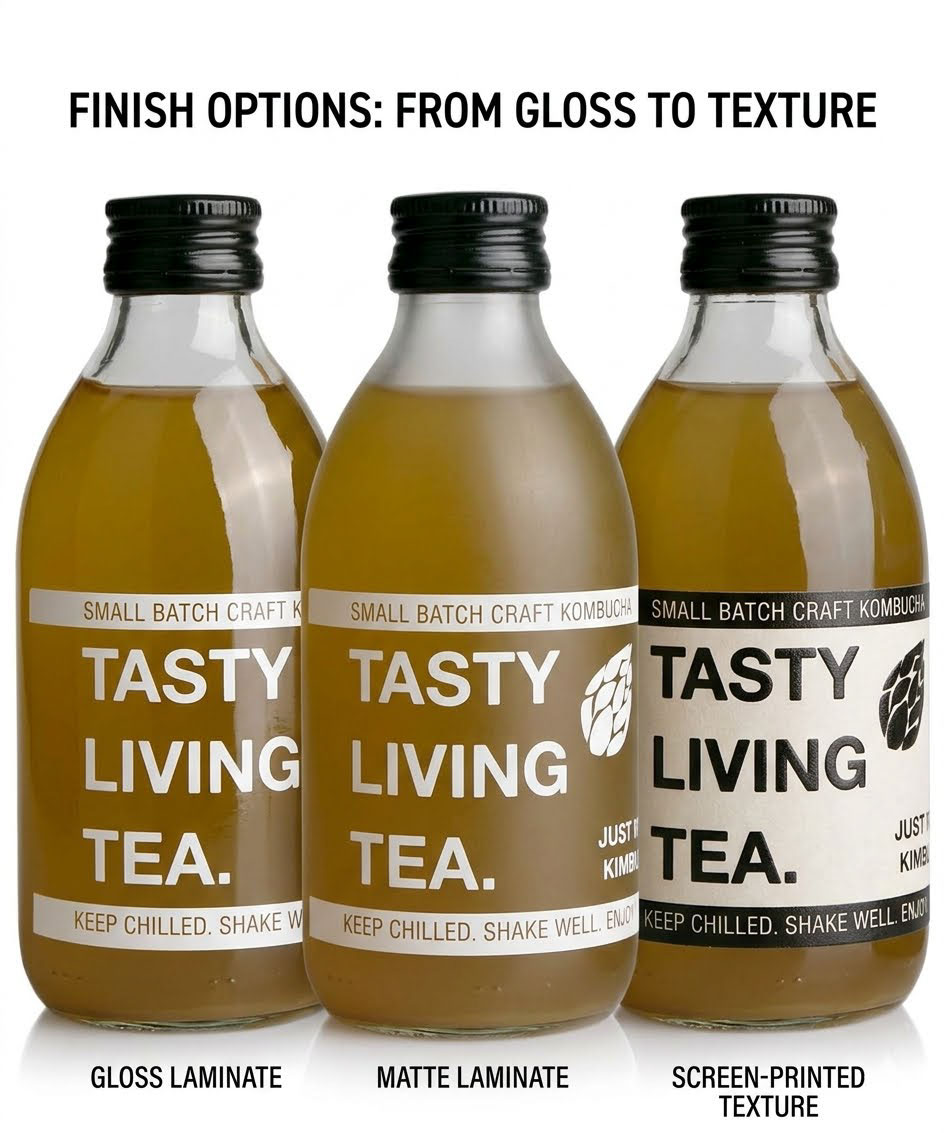
Gloss laminate → Mirrors the glass shine, best for wine/spirits.
Matte laminate → Soft, natural feel; hides small application bubbles.
Cold foil → Striking on clear film over dark glass (creates a "floating metallic" effect).
Screen-printed texture → Tactile varnish on clear film for premium cosmetic labels.
StickerForgeco offers all of these. We often recommend matte lam for first-time clear label users—it's the most forgiving and looks "expensive."
Use this when discussing a new project with StickerForgeco:
Bottle diameter & curvature (send a photo or sample bottle)
Product fill color (amber, clear, white, etc.)
Expected conditions (ambient, refrigerated, freezer, wet ice)
White underprint needed for which design elements?
Regulatory copy size – smallest font height
Matte or gloss finish? Any foil or embossing?
Recyclability requirement? (wash-off adhesive available)
We don't just print labels—we engineer adhesive solutions for glass. Here's what sets us apart:
In-house adhesive selection – We stock 6 different clear acrylics, including fog-resistant and freezer-grade.
Variable white opacity – True grayscale white ink, not just 0% or 100%.
Test before you run – We can print sample labels on your actual bottle for a nominal fee (credited to production).
Fast turnaround – Most clear BOPP orders ship in 3 business days.
Clear labels on glass bottles create one of the most premium packaging effects available. But they fail fast when built with commodity materials.
Whether you need a "no-label look" for a craft soda, a clear-on-clear cosmetic label, or a freezer-grade beer label—StickerForgeco has the engineering and printing expertise to make it work.
📧 Ready to test? Send us your bottle and artwork file. We'll produce a white-underprint proof within 24 hours.



 +8618128095554
 sales@stickerforgeco.com
 +8618128095554